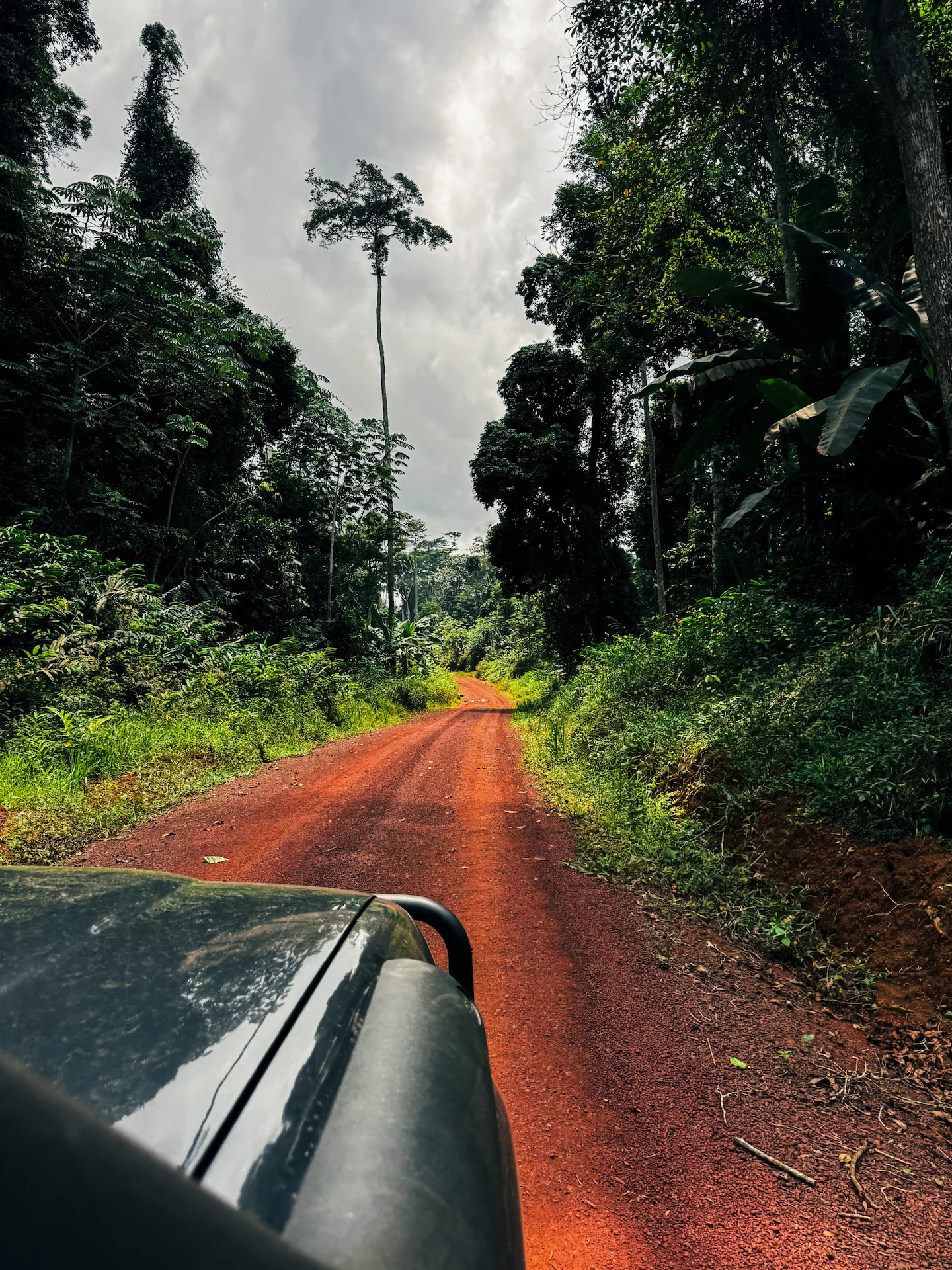
This expedition takes you through some of the most remote and least developed regions in the world. No infrastructure, no guaranteed schedules, no comfort zone.
That is exactly why you want someone with you who knows how it works.




At some point everything familiar falls away. No home, no everyday life, no routine. Instead: landscapes without end, evenings around the fire, the stars above you. You notice how much is actually possible. What stays is the feeling of having done it.

We organise visas, checkpoints and paperwork. You just drive through.
Johnny knows every kilometre from his own experience. The safest roads, the best camp spots, the detours worth taking.

Six vehicles at most. You set off as strangers and arrive as a team. You decide together, help each other out and share the evenings around the fire.
Led by Johnny.
Morocco is a gentle start. Souks, the Atlas mountains and the first off-road sections in the Sahara. Then south along the Atlantic coast through Western Sahara. In Mauritania it gets serious: sand, heat and long, empty stretches. We sleep between the dunes, pick out constellations in the night sky and cook over an open fire.
Senegal changes everything: more life, more colour, more chaos. In The Gambia we follow the Gambia River deep inland and, with a bit of luck, see chimpanzees. Guinea is one of the least developed countries on the whole route: potholes, red pistes, small villages and untouched waterfalls.
Beaches, tropical rainforest and loud, restless cities take turns. In Ghana, Togo and Benin we get into the cultural range of the region: local markets, voodoo, and the colonial history that follows us eastwards. Nigeria is one of the most intense stretches of the whole trip: loud, chaotic and full of energy.
We reach Cameroon after days on off-road tracks in the Nigerian mountains. In the Republic of the Congo we look for chimpanzees and gorillas before catching our breath in Brazzaville. DR Congo has the hardest and perhaps the finest off-road section of the whole trip.
In Angola the landscape opens up. Wide savannah, remote coastline, long horizons. Namibia begins the calmer part: campsites, lodges and more infrastructure, but also wildlife and some of the best scenery on the route.
The last kilometres take us into South Africa. We reach Cape Town, the southernmost point of this trip and one of the most beautiful places in the world.
Expected from 14,990 euros per person
Johnny knows the continent as few people do. He has been travelling in Africa since 2010: a year living in Cape Town, expeditions through Namibia and Tanzania, and then the full crossing from Europe to Cape Town, 23,000 kilometres, 21 countries, 140 days. He plans the route, organises visas and border crossings, and works out the safest roads and the best camp spots. So you can concentrate on what you came for: Africa itself. And he is not doing it alone. A second experienced guide travels with the expedition.
Join the waiting listThe things we are asked most often.
Expected from 14,990 euros per person, based on two people per vehicle. If you travel alone in a vehicle there is a supplement of 7,990 euros, because the vehicle related costs on our side are not shared. The price includes expedition leadership, organisation, daily route guidance, hotels, campsites, tours, satellite internet, radios and the meet-the-group weekend before departure. It does not include fuel, visas, food, insurance or your flight home.
The biggest items are fuel (roughly 3,000 to 4,000 euros depending on your vehicle) and visas (roughly 1,500 euros per person). Food varies a lot: shopping at local markets is cheap, while imported goods in the capitals can cost more than they do in Europe.
Yes. You drive your own 4x4. Johnny leads the convoy and helps when something breaks, but everyone drives themselves. For tyres we recommend all terrain.
Yes, of course. You do not have to come as a couple. The group is deliberately small, six vehicles at most, and you all meet each other at the weekend before departure.
The west route is currently the only way to drive right through Africa from north to south. Every country on it is passable. It is also the most interesting route, with the most countries and the most cultures along the way.
No. You learn it on the way. We start on easy pistes and build up step by step, until the group handles the difficult sections too. Johnny drives ahead and knows every passage.
We recommend an appointment at a tropical medicine institute, in our case the one in Hamburg. Yellow fever vaccination is mandatory in many West African countries. Beyond that, hepatitis A and B, tetanus, typhoid and polio are recommended. There is no vaccine against malaria; protection comes from prophylaxis such as Malarone and from being consistent about mosquito protection.
We provide a detailed packing list: vehicle equipment, tools, provisions, your own medical kit and the small things that turn out to be useful. You do not have to work it out on your own.
We set off after breakfast and drive five to six days a week on average. We reach the camp spot in the afternoon, which leaves time to look around, cook and do nothing. In between there are rest days for visas, vehicle maintenance, recovery and whatever there is to see.
This trip goes through areas with no tourist infrastructure. We plan carefully, we know the route from our own experience, we carry satellite internet, GPS and a comprehensive medical kit, and we know the hospitals and clinics along the way. Risk can never be ruled out completely, but with experience and preparation it can be managed well.
It is hard, at times. A new environment every few days, a lot to take in, temperatures that swing, nowhere to retreat to, curious people everywhere, border crossings and police checks. This is not an easy holiday. It is an expedition.
We check the vehicles regularly and deal with problems before they grow. If something does break, we get the vehicle to the nearest garage and have it repaired there. Johnny knows garages along the route, and the group helps each other out.
That is what the weekend before departure is for. You meet each other there. The group is small, and wanting to drive across Africa is a lot to have in common.
That is not the plan. If it becomes necessary, it is possible. There are international airports in the larger cities with flights to Paris, Brussels, London or Frankfurt. Your vehicle can be stored safely with selected partners or shipped home.
We work with an experienced shipping agent in Cape Town who sends the vehicles to Rotterdam by container, safely and at competitive rates. You can also leave your vehicle there and have it shipped at a later date.
Every border is different. Usually you check out of one country and into the next, people on the passport and the vehicle on the Carnet de Passages. Johnny knows all the crossings on the route and handles the organisation.
These terms apply from the opening of bookings for 2027/28. The waiting list is free and commits you to nothing. A place is reserved with a deposit of 30 per cent. The balance is due 90 days before departure. The expedition runs with a minimum of 4 vehicles and a maximum of 6. If the minimum is not reached, we reserve the right to withdraw up to 120 days before departure. In that case every payment made is refunded in full.
If you cancel, the following applies: up to 120 days before departure the deposit is forfeited. From 119 to 60 days, 50 per cent is due; from 59 to 30 days, 75 per cent; from 29 days, the full price. Cancellation insurance is therefore strongly recommended. An expedition like this takes months of preparation for everyone involved, which is why late cancellations are not possible.
The first expedition sets off in the winter of 2027/28. That gives you enough time to arrange a sabbatical, a vehicle and the paperwork. Put your name on the waiting list, with no commitment: you will be the first to hear the exact date and you can reserve a place before anyone else.
Thank you, you are on the waiting list. We will be in touch.